UK’s consolidated budget is composed of three fund groups: general, auxiliary and restricted. Each fund group is budgeted so that it is balanced – revenues plus transfers equals expenses.
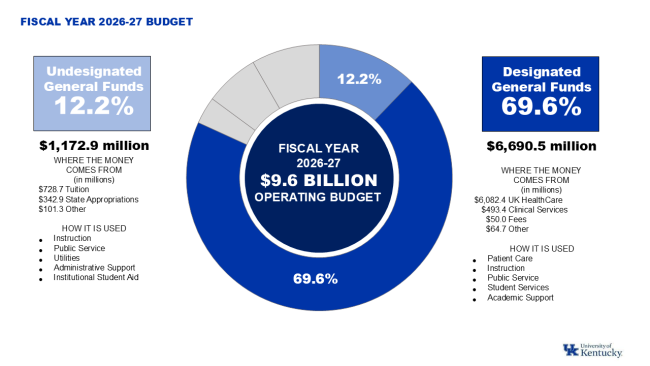
Undesignated and Designated General Funds are unrestricted resources that comprise the majority of the university’s operating budget. Undesignated General Funds support core instruction, public service, student support and administrative functions. Designated General Funds support specific missions, such as UK HealthCare.
Undesignated General Funds
Undesignated General Funds include state appropriations, student tuition, and other income. These revenues are received and managed centrally with the associated expenditure authority allocated to colleges and departments. For FY 2026-27, Undesignated General Funds comprise 12.2 percent of the university’s total budget.
Designated General Funds
Designated General Funds are received directly by the colleges, departments and enterprises that receive or earn the revenue. Units use the funds in accordance with the stated purpose of the funds and the units’ missions. For FY 2026-27, Designated General Funds comprise 69.6 percent of the University’s total budget. At a projected budget of $6.7 billion, the university’s largest revenue source, classified as Designated General Funds, is from UK Healthcare and associated professional clinical care.
Auxiliary Funds
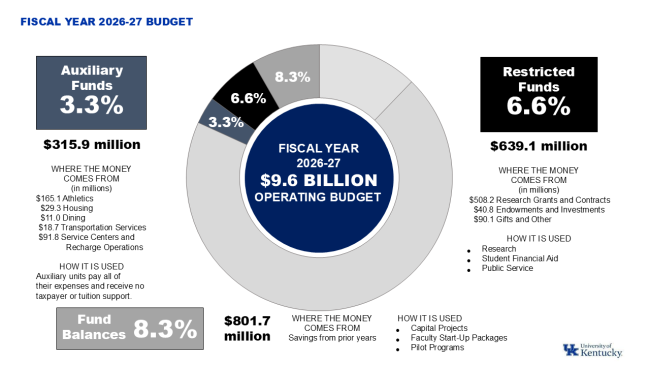
Auxiliary Funds are generated from the sale of goods and services to faculty, staff, students and the community. Revenues are expected to cover the operating expenses of each auxiliary enterprise. Athletics, Campus Housing, Dining, Transportation Services, service centers and recharge operations generate the majority of Auxiliary Funds. For FY 2026-27, Auxiliary Funds comprise 3.3 percent of the university’s consolidated budget.
Restricted Funds
Restricted Funds are accepted by the university with explicit constraints imposed by external entities or donors. The primary sources of Restricted Funds are sponsored projects such as grants and contracts, gifts that must be spent in support of specific programs, and federal and state student financial aid. 1.
The university has a legal obligation to abide by the restrictions. For FY 2026-27, Restricted Funds constitute 6.6 percent of the university’s total budget.
Fund Balances
The university’s operating budget includes expenditure authority for prior-year unspent funds (i.e., Fund Balances) accumulated within each of the primary fund groups (Undesignated General Funds, Designated General Funds , Auxiliary Funds and Restricted Funds). Fund balances are considered non-recurring or one-time funds. For FY 2026-27, Fund Balances account for 8.3 percent of the university’s consolidated budget.